
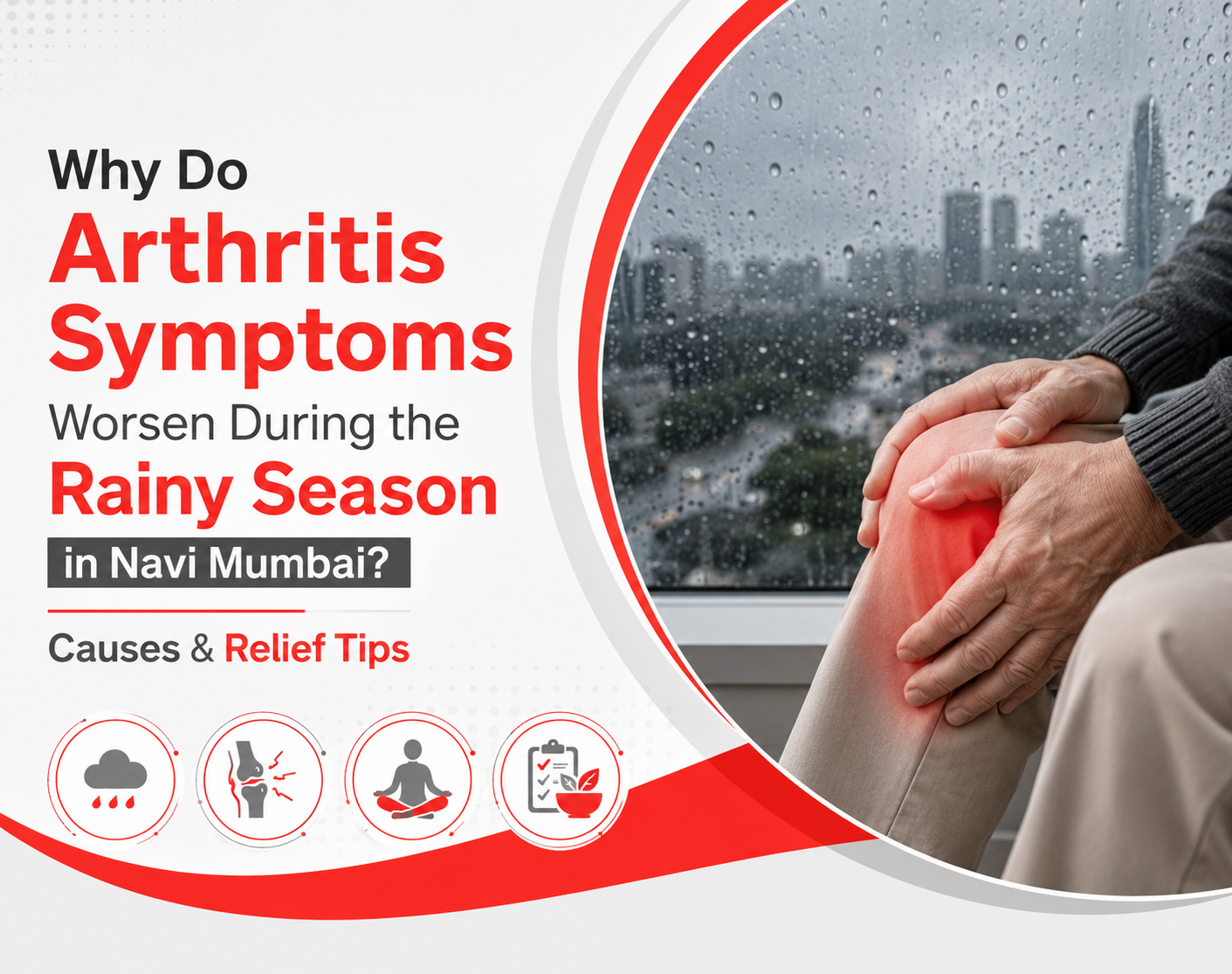
Managing monsoon arthritis pain in Navi Mumbai starts with understanding why it happens in the first place.If you live with arthritis, you have probably noticed something that does not feel like a coincidence the moment the monsoon arrives in Navi Mumbai, your joints seem to know it before the clouds even open up. The aching gets sharper. The stiffness in your knees feels heavier. Getting out of bed in the morning becomes a battle.
You are not imagining it. Arthritis symptoms genuinely worsen during the rainy season, and there are clear medical reasons why. This blog explains exactly what happens to your joints during monsoon, what you can do to manage it, and when it is time to consult an orthopaedic specialist for arthritis treatment in Navi Mumbai.
Does Rainy Weather Really Affect Arthritis?
Yes — and it is not just anecdotal. Many orthopaedic doctors, including specialists treating arthritis in Navi Mumbai, observe a consistent pattern every year: patient visits for joint pain, knee stiffness, and arthritic flare-ups increase significantly during the monsoon months of June through September.
Research suggests that falling atmospheric pressure, rising humidity, and reduced physical activity during rainy weather all create conditions that aggravate inflamed joints. Whether you have osteoarthritis, rheumatoid arthritis, or gout, the monsoon puts additional stress on an already sensitive joint environment.
Why Monsoon Arthritis Pain Gets Worse: Key Causes
Understanding what is happening inside your joints helps you take control. Here are the four primary reasons arthritis gets worse in the rainy season:
Drop in Atmospheric Pressure
When a weather system brings rain, barometric pressure the weight of air around us drops. For healthy joints, this change is negligible. But for joints already affected by arthritis, the tissues around the joint are more sensitive. When external pressure drops, tissues inside the joint can expand slightly, causing increased swelling, pressure, and pain. This is why many arthritis patients in Navi Mumbai report that their pain worsens even before it starts raining.
Increased Humidity
High humidity affects the viscosity of the synovial fluid the natural lubricant inside your joints. When humidity rises, joint lubrication can become less effective, leading to greater friction between joint surfaces. For patients with osteoarthritis, where cartilage is already worn down, this friction translates directly to increased pain and a grinding sensation in the knee, hip, or shoulder.
Reduced Physical Activity
Monsoon naturally discourages movement. Wet roads, flooding in areas like Kopar Khairane, Sanpada, and Kharghar, and the general reluctance to step out mean that arthritis patients become more sedentary. However, inactivity is one of the worst things for arthritic joints. When you stop moving, the muscles supporting your joints weaken, blood circulation decreases, and stiffness sets in faster. For elderly patients in Vashi and Nerul who already struggle with joint mobility, even a few inactive days during monsoon can cause a noticeable step back.
Joint Stiffness from Cold and Damp Conditions
The cooler, damp air during Navi Mumbai’s monsoon causes muscles around the joints to contract and tighten. This muscle tightening reduces joint flexibility and increases the effort needed for simple movements like climbing stairs, sitting down, or bending the knee. Morning stiffness already a hallmark of arthritis feels significantly worse on cold, wet mornings.
Common Symptoms Patients Notice During Monsoon
Arthritis patients across Navi Mumbai from Belapur and CBD Belapur to Panvel and Vashi typically report the following symptoms getting worse during the rainy season:
- Increased joint pain, especially in the knees, hips, and lower back
- Greater morning stiffness lasting longer than usual
- Swelling and puffiness around the affected joint
- A warm sensation or redness around the joint
- Clicking, grinding, or popping sounds when moving the joint
- Reduced range of motion — difficulty folding the knee fully or raising the arm
- Fatigue and a general sense of heaviness in the body
If these symptoms are interfering with your daily routine, they should not be brushed off as a seasonal nuisance.
Tips to Manage Arthritis During Monsoon
There are practical, evidence-backed steps you can take to reduce the impact of monsoon weather on your joints:
Stay Warm and Dry: Keep the affected joints covered using light woollens or compression sleeves. Avoid sitting directly under air conditioning or in damp rooms for long periods.
Keep Moving Indoors: Do not give up on physical activity just because it is raining. Gentle indoor exercises — knee bends, ankle rotations, seated leg raises, and light stretching help maintain joint flexibility and muscle strength without the risk of a wet-weather fall.
Apply Heat Therapy: A warm compress or heating pad applied to stiff joints for 15 to 20 minutes helps relax the surrounding muscles and improve blood flow to the area. This is particularly effective for morning stiffness in the knee and lower back.
Follow an Anti-Inflammatory Diet: During monsoon, focus on foods that naturally reduce joint inflammation omega-3-rich fish like salmon and mackerel, walnuts, turmeric, ginger, and leafy vegetables. Avoid processed foods, excess salt, and cold beverages that can worsen joint swelling.
Maintain a Healthy Weight: Every kilogram of excess body weight places approximately four kilograms of additional load on your knee joints. Managing weight is one of the most effective non-surgical arthritis interventions available.
Stay Consistent with Medication: If your orthopaedic doctor has prescribed anti-inflammatory medications or supplements like Vitamin D and calcium, do not skip doses during monsoon. Vitamin D deficiency already common in Mumbai due to reduced sun exposure during the rains directly worsens joint and bone pain.
When Should You See an Orthopaedic Specialist?
Home care helps, but there are clear signs that you need professional evaluation for arthritis treatment in Navi Mumbai:
- Pain that persists for more than two to three weeks despite rest and home care
- Swelling that does not reduce with elevation or ice
- Stiffness that makes normal walking or climbing stairs very difficult
- A sudden sharp increase in pain compared to your usual baseline
- Fever along with joint pain (this may indicate infectious or reactive arthritis)
- Significant change in the shape or appearance of the joint
Do not wait for the monsoon to pass and hope the pain resolves on its own. Untreated arthritis progresses over time, and early intervention almost always leads to better outcomes.
Arthritis Treatment Options Available in Navi Mumbai
At Synthesis Orthopaedic and Joint Replacement Clinic, arthritis care is tailored to the severity of each patient’s condition. Treatment options include:
Non-Surgical Options:
- Anti-inflammatory medications and pain management protocols
- Intra-articular injections including corticosteroids and PRP (Platelet-Rich Plasma) injections to reduce inflammation and promote healing
- Guided physiotherapy and joint mobility exercises
- Lifestyle modification counselling including diet and weight management
Surgical Options (for Advanced Cases):
- Minimally Invasive Knee Replacement using Rapid Recovery Protocol
- Total Hip Replacement for severe hip arthritis
- Partial joint replacement where only the damaged portion is addressed
Dr. Chavhan’s internationally trained approach prioritises non-surgical management first. Surgery is recommended only when conservative treatment no longer provides adequate relief and the patient’s quality of life is significantly impacted.
Why Choose Dr. Suyog Chavhan for Arthritis Treatment?
Dr. Suyog B. Chavhan is an orthopaedic surgeon with advanced fellowship training in Hip and Knee Joint Replacement from England, United Kingdom, and additional fellowship training in Complex Trauma from Seoul, South Korea. He practices across leading hospitals in Navi Mumbai including Kokilaben Dhirubhai Ambani Hospital (Kopar Khairane), MGM Hospital (Vashi), Zynova Shalby Hospital (Ghatkopar), and several others.
Patients consulting Dr. Chavhan for arthritis treatment in Navi Mumbai benefit from:
- Accurate grading and diagnosis of arthritis using clinical assessment and imaging
- Personalised treatment plans non-surgical first, surgical only when indicated
- Minimally invasive surgical techniques that ensure faster recovery and less post-operative pain
- Clinics accessible across Vashi, Kopar Khairane, Sanpada, CBD Belapur, and Kharghar
- Transparent communication patients are clearly explained every step of their treatment
FAQs
Q1. Can monsoon weather directly cause arthritis?
No the rainy season does not cause arthritis. However, it aggravates existing arthritis by triggering joint inflammation, reducing lubrication, and promoting inactivity. If you are already arthritic, monsoon puts extra stress on your joints.
Q2. Which type of arthritis is most affected by monsoon?
Osteoarthritis and rheumatoid arthritis are both affected, though patients with osteoarthritis particularly knee osteoarthritis report the most noticeable seasonal worsening. Gout flare-ups can also increase in humid weather.
Q3. Is it safe to exercise during monsoon if I have arthritis?
Yes and it is strongly recommended. The key is to choose low-impact, indoor exercises. Avoid high-impact activity, uneven surfaces, or wet outdoor areas that increase the risk of falls.
Q4. Should I use ice or heat for arthritis pain during monsoon?
Heat is generally more beneficial for arthritis-related stiffness. Cold packs are better for acute swelling immediately after a flare. If you are unsure, consult your orthopaedic doctor for specific guidance.
Q5. How do I know if I need knee replacement for my arthritis?
If your knee pain limits daily activities walking, climbing stairs, or sitting and rising from a chair and conservative treatments including medication and physiotherapy no longer help, it may be time to evaluate surgical options. Dr. Suyog Chavhan performs a full clinical and X-ray assessment before any surgical recommendation is made.
Conclusion
Monsoon in Navi Mumbai brings relief from the summer heat but for arthritis patients, it often brings increased pain, stiffness, and frustration. The good news is that this seasonal worsening is manageable. With the right combination of home care, consistent medication, indoor exercise, and timely professional consultation, you can get through the rainy season with significantly less discomfort.
If your joint pain is making this monsoon difficult, do not wait. Reach out to Dr. Suyog Chavhan one of Navi Mumbai’s trusted orthopaedic specialists and get a clear diagnosis, a personalised treatment plan, and real relief.
📞 Call: +91 90826 33731
📍 Clinics across Vashi, Kopar Khairane, Sanpada, CBD Belapur, and Kharghar